Types of Leather Adhesives, Their Applications & How to Choose the Right Leather Adhesive
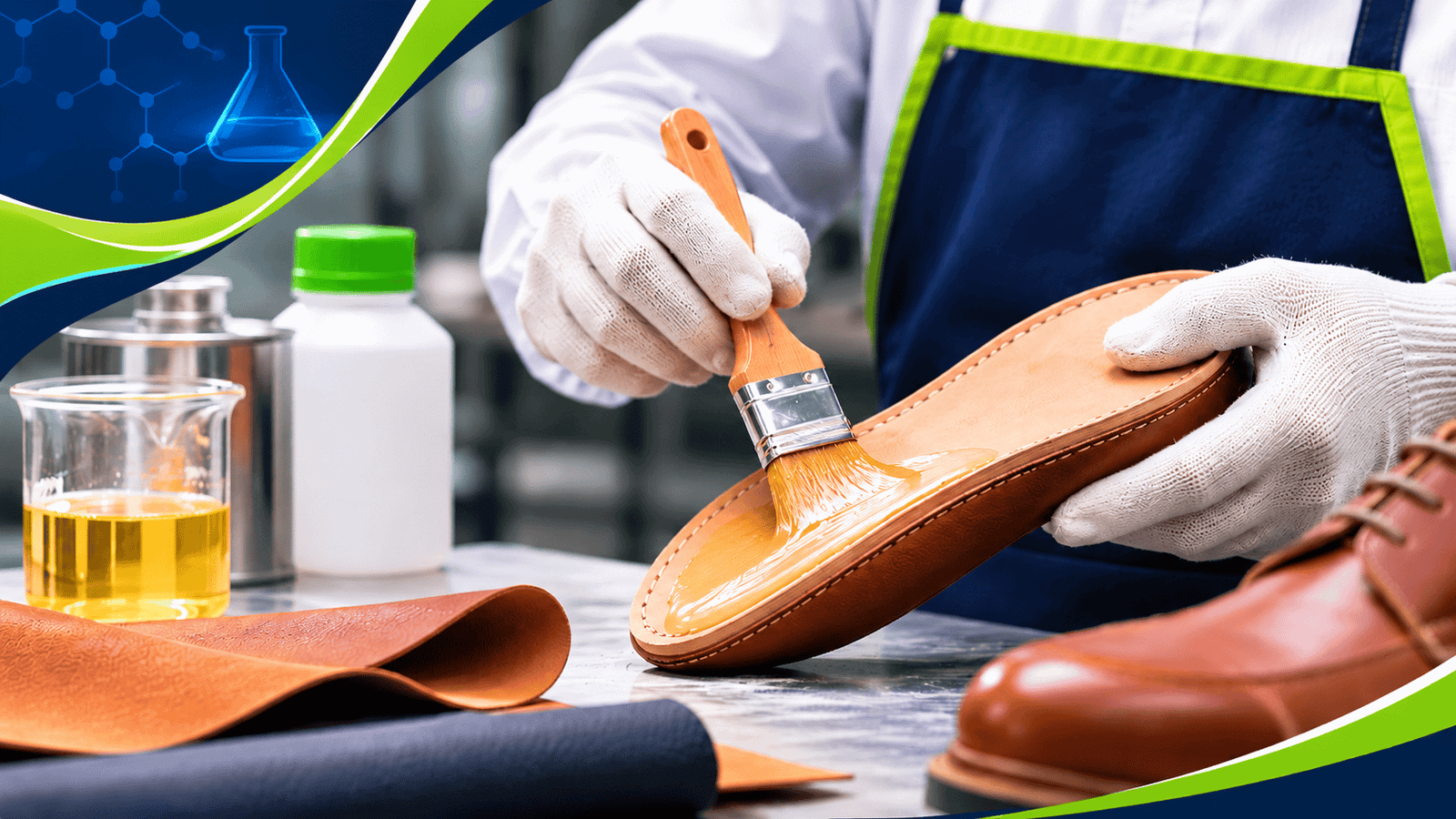
Leather manufacturing involves several processes where strong, reliable and flexible bonding is essential. From footwear production and leather bags to automotive upholstery, furniture and fashion accessories, adhesives play a crucial role in ensuring product durability, appearance and performance.
Choosing the right leather adhesive is not simply about finding a glue that sticks two surfaces together. The adhesive must be compatible with the leather type, provide the required bonding strength, maintain flexibility, withstand environmental conditions and support the production process.
Different applications require different adhesive formulations. A footwear manufacturer may need an adhesive with excellent heat resistance and strong bonding properties, while a leather goods manufacturer may prioritise flexibility, transparency and a clean finish.
With several types of leather adhesives available in the market, understanding their properties and applications is important for achieving consistent manufacturing results.
In this comprehensive guide, we will explore the different types of leather adhesives, their industrial applications, important selection criteria and factors that influence bonding performance.
What Is Leather Adhesive?
Leather adhesive is a specialised bonding formulation designed to join leather with other materials or bond two leather surfaces together. Depending on its chemical composition, it can provide temporary positioning, flexible bonding or high-strength permanent adhesion.
Leather adhesives are widely used in the manufacturing of:
- Leather footwear and shoes
- Leather bags and handbags
- Wallets, belts and accessories
- Automotive leather interiors
- Leather furniture and upholstery
- Safety shoes and industrial footwear
- Leather garments and fashion products
- Leather goods and lifestyle accessories
Unlike conventional household glue, industrial leather adhesives are developed to meet specific manufacturing requirements, including flexibility, resistance to peeling, heat tolerance and compatibility with different substrates.
The performance of an adhesive depends on several factors, including its formulation, application method, surface preparation, drying conditions and the materials being bonded.
Why Is Choosing the Right Leather Adhesive Important?
Leather is a flexible and relatively complex material. Its surface characteristics vary depending on the tanning method, finishing treatment, coating, thickness and intended application.
Using an unsuitable adhesive can lead to several manufacturing problems.
1. Weak Bonding Strength
An incompatible adhesive may not develop sufficient adhesion, causing bonded components to separate during handling or regular use.
2. Loss of Flexibility
Leather products are frequently bent, folded and stretched. An adhesive that becomes too rigid after curing may crack or weaken when the material is repeatedly flexed.
3. Surface Damage and Staining
Certain adhesive formulations may cause discoloration, visible marks or damage to delicate leather finishes.
4. Poor Heat Resistance
Footwear, automotive interiors and other leather products can be exposed to elevated temperatures. Adhesives without suitable heat resistance may soften or lose bonding strength.
5. Production Inefficiency
Incorrect adhesive selection can increase drying time, rework, material wastage and production costs.
Selecting an adhesive based on the final product’s requirements helps manufacturers achieve better bonding consistency and long-term product quality.
Types of Leather Adhesives Used in Industrial Applications
Leather adhesives are available in different chemical formulations. Each type offers distinct properties and is suitable for particular manufacturing applications.
The following are some commonly used adhesive technologies in the leather and footwear industries.
1. Polyurethane (PU) Adhesives
Polyurethane adhesives are widely used in industrial bonding applications because of their versatility, flexibility and strong adhesion to suitable substrates.
Depending on their formulation, PU adhesives can provide excellent bonding performance between leather and materials such as rubber, synthetic leather, textiles and selected plastics.
Key characteristics:
- Strong adhesion to compatible substrates
- Good flexibility after curing
- Resistance to repeated bending
- Available in different solvent-based and water-based formulations
- Suitable for demanding footwear and leather goods applications
Applications:
- Leather footwear manufacturing
- Shoe sole bonding
- Leather bags and accessories
- Automotive upholstery
- Leather-to-textile bonding
- Industrial leather products
PU adhesives are particularly useful when the finished product requires a combination of bonding strength and flexibility.
2. Polychloroprene (CR) or Neoprene Adhesives
Polychloroprene adhesives, commonly known as neoprene or contact adhesives, are frequently used in footwear and leather goods manufacturing.
They generally offer good initial tack, allowing manufacturers to bond components efficiently after applying the adhesive to the appropriate surfaces and allowing the required evaporation time.
Key characteristics:
- Good initial bonding strength
- Fast development of handling strength
- Suitable for contact bonding processes
- Good flexibility in many applications
- Available in formulations for different substrates
Applications:
- Leather shoe uppers
- Footwear lining
- Leather-to-rubber bonding
- Bag manufacturing
- Leather wallets and accessories
- Upholstery applications
These adhesives are useful in manufacturing processes where fast assembly and reliable contact bonding are important.
3. Water-Based Leather Adhesives
Water-based leather adhesives use water as the primary carrier instead of conventional organic solvents.
They are increasingly considered by manufacturers looking to reduce solvent use and improve workplace conditions.
Key characteristics:
- Water-based formulation
- Lower VOC potential compared with many conventional solvent-based products
- Reduced solvent odour
- Suitable for selected leather and textile bonding applications
- Available in different flexibility and strength grades
Applications:
- Leather bags and wallets
- Leather garments
- Textile and leather bonding
- Selected footwear components
- Leather upholstery
- General leather goods manufacturing
It is important to understand that water-based does not automatically mean non-toxic, hazard-free or biodegradable. Manufacturers should always check the product’s technical data sheet and safety data sheet.
4. Acrylic Adhesives
Acrylic-based adhesives are used in various industrial bonding applications where specific adhesion, film properties and processing characteristics are required.
Their performance depends considerably on the acrylic polymer system and formulation.
Key characteristics:
- Available in water-based and other formulation systems
- Can provide good adhesion to selected substrates
- Available in flexible and rigid grades
- Suitable for specialised bonding applications
- Can offer good appearance and film properties
Applications:
- Leather accessories
- Textile lamination
- Decorative leather components
- Selected synthetic leather applications
- Specialised leather finishing and assembly
The correct acrylic formulation should be selected according to the substrate and required bonding performance.
5. EVA-Based Adhesives
Ethylene-vinyl acetate (EVA) adhesives are used in footwear and other manufacturing applications, particularly in hot-melt adhesive systems.
They are valued for their processing convenience and suitability for selected bonding requirements.
Key characteristics:
- Available in hot-melt formulations
- Rapid setting after cooling
- Suitable for automated production systems
- Available in different viscosity and softening-point grades
- Can bond selected leather, foam, textile and synthetic materials
Applications:
- Footwear assembly
- Insole bonding
- Foam and textile bonding
- Selected leather accessories
- Industrial product assembly
EVA adhesives should be selected carefully when the final product will be exposed to high temperatures or repeated mechanical stress.
6. Hot-Melt Adhesives
Hot-melt adhesives are applied in a molten state and develop bonding strength as they cool and solidify.
They are commonly used in automated manufacturing processes where speed and consistent application are important.
Hot-melt adhesives may be formulated using EVA, polyamide, polyurethane and other polymer technologies.
Key characteristics:
- Rapid setting
- No conventional solvent evaporation required
- Suitable for automated application
- Consistent application when processing conditions are controlled
- Available in different flexibility and temperature-resistance grades
Applications:
- Shoe manufacturing
- Leather component assembly
- Edge and lining applications
- Textile lamination
- Industrial leather goods
The adhesive’s open time, application temperature and heat resistance must match the production requirements.
7. Epoxy Adhesives
Epoxy adhesives are generally used for specialised applications requiring rigid, high-strength bonding.
They are not usually the first choice for flexible leather-to-leather bonding because some cured epoxy systems can become too rigid for materials that undergo continuous bending.
Key characteristics:
- High strength in suitable applications
- Good adhesion to selected substrates
- Available in two-component systems
- Good chemical and environmental resistance in certain formulations
- Can produce relatively rigid bonds
Applications:
- Specialised leather product components
- Bonding selected metal or rigid accessories
- Decorative hardware attachment
- Certain industrial assembly applications
Epoxy adhesives should only be used where their cured properties are compatible with the finished product.
Comparison of Different Leather Adhesive Types
| Adhesive type | Main advantage | Common applications |
|---|---|---|
| PU adhesive | Flexible, strong bonding | Footwear, leather goods |
| Neoprene adhesive | Good initial tack | Shoe uppers, bags |
| Water-based adhesive | Reduced solvent use | Leather goods, textiles |
| Acrylic adhesive | Formulation versatility | Specialised leather applications |
| EVA adhesive | Convenient processing | Footwear, assembly |
| Hot-melt adhesive | Fast setting | Automated manufacturing |
| Epoxy adhesive | Rigid, high-strength bonding | Specialised components |
The above comparison is a general guide. Actual performance varies by formulation, grade, substrate and processing conditions.
Major Applications of Leather Adhesives Across Industries
Leather adhesives are used throughout the manufacturing process, from component assembly to final product finishing.
1. Footwear Manufacturing
Footwear is one of the largest industrial application areas for leather adhesives.
Shoes contain multiple components that need to be bonded securely while retaining flexibility during walking and everyday use.
Common bonding applications include:
- Leather upper-to-lining bonding
- Sole attachment
- Insole bonding
- Heel component assembly
- Reinforcement material bonding
- Leather-to-rubber bonding
- Leather-to-EVA bonding
For footwear manufacturing, adhesive selection should consider peel strength, heat resistance, flexibility, open time and compatibility with sole materials.
2. Leather Bag and Handbag Manufacturing
Leather bags require clean, durable and aesthetically pleasing bonding.
Adhesives are used to assemble different components while maintaining the original appearance and flexibility of the leather.
Typical applications include:
- Leather panel bonding
- Pocket assembly
- Lining attachment
- Reinforcement bonding
- Strap assembly
- Decorative component attachment
For premium leather goods, manufacturers should pay particular attention to adhesive transparency, staining potential and the appearance of bonded edges.
3. Wallets, Belts and Leather Accessories
Small leather goods require accurate bonding and a clean finish.
Adhesives are commonly used for:
- Multi-layer leather bonding
- Belt lining
- Wallet compartment assembly
- Cardholder manufacturing
- Leather strap construction
- Decorative leather components
The adhesive should provide sufficient strength without creating an unnecessarily thick or rigid bond line.
4. Automotive Leather Upholstery
Automotive leather interiors require adhesives that can withstand demanding environmental conditions.
Bonding applications include:
- Seat upholstery
- Door panel covering
- Dashboard components
- Interior trim
- Foam-to-leather bonding
- Leather-to-fabric bonding
Important selection parameters include temperature resistance, ageing performance, odour requirements, flexibility and compatibility with automotive material specifications.
5. Furniture and Upholstery
Leather furniture manufacturing involves bonding leather with foam, fabric, wooden components and other materials.
Common applications include:
- Sofa upholstery
- Chair coverings
- Cushion assembly
- Leather panel attachment
- Foam bonding
- Decorative upholstery components
Adhesives should be selected based on the surface characteristics of the materials and the expected service conditions.
6. Industrial Leather Goods
Industrial applications may require bonding solutions for protective equipment, specialised leather products and heavy-duty leather components.
These applications can involve different substrate combinations and performance requirements.
Adhesive selection should therefore be based on the intended working environment, mechanical stress and applicable product specifications.
How to Choose the Right Leather Adhesive
Selecting the right leather adhesive requires understanding the materials, production process and performance expectations of the finished product.
Here are the most important factors manufacturers should evaluate.
1. Identify the Materials Being Bonded
The first step is identifying both surfaces.
Are you bonding:
- Leather to leather?
- Leather to rubber?
- Leather to PU?
- Leather to PVC?
- Leather to EVA?
- Leather to fabric?
- Leather to foam?
Different materials have different surface energies, porosity and chemical compatibility. An adhesive suitable for leather-to-leather bonding may not perform equally well when bonding leather to rubber or plastic.
Always select an adhesive designed for the specific substrate combination.
2. Consider the Type of Leather
Not all leather surfaces behave in the same way.
Important considerations include:
- Full-grain leather
- Corrected-grain leather
- Finished leather
- Suede and nubuck
- Coated leather
- Synthetic leather
- PU and PVC materials
Heavily finished or coated leather may require a different adhesive or surface preparation method compared with untreated or absorbent leather.
3. Evaluate Required Bonding Strength
Different products require different levels of adhesion.
For example, a decorative leather accessory may have different bonding requirements from a footwear sole that experiences continuous mechanical stress.
Consider:
- Peel strength
- Initial tack
- Final bond strength
- Shear resistance
- Resistance to repeated flexing
The adhesive should meet the mechanical requirements of the finished product.
4. Check Flexibility
Flexibility is particularly important in footwear, bags, belts and upholstery.
An adhesive that becomes excessively rigid can cause cracking, delamination or discomfort during product use.
For flexible leather applications, select a formulation designed to maintain the required elasticity after curing.
5. Evaluate Heat and Water Resistance
The working environment of the finished product should influence adhesive selection.
Footwear may be exposed to heat, moisture and repeated bending. Automotive interiors can experience high cabin temperatures, while furniture may be exposed to cleaning agents and humidity.
Check the adhesive’s:
- Heat resistance
- Water resistance
- Humidity resistance
- Ageing characteristics
- Environmental durability
Do not assume that every PU, neoprene or water-based adhesive offers the same resistance. These properties are grade-specific.
6. Understand Drying Time and Open Time
Drying time and open time are important production parameters.
Drying time refers to the time required for the adhesive to reach the desired condition before the next manufacturing step.
Open time refers to the period during which the adhesive remains suitable for bonding after application.
Manufacturers should select products that fit their production speed, application method and assembly requirements.
7. Consider the Application Method
Leather adhesives may be applied using:
- Brush application
- Roller application
- Spray application
- Manual spreading
- Automatic dispensing systems
- Hot-melt application equipment
The adhesive’s viscosity and formulation must be suitable for the selected application equipment.
8. Check Environmental and Safety Requirements
Manufacturers should consider VOC content, solvent handling requirements, workplace ventilation, flammability and applicable regulatory standards.
Water-based adhesives may help reduce solvent use in suitable applications, but all adhesive products should be handled according to their safety data sheets.
Common Leather Adhesive Problems and Their Solutions
Even a suitable adhesive can produce poor results if the application process is not properly controlled.
Here are some common bonding problems and possible corrective measures.
Problem 1: Leather Surfaces Separating After Bonding
Possible reasons:
- Incompatible adhesive
- Incorrect drying conditions
- Insufficient pressure
- Poor surface preparation
- Inadequate adhesive coverage
Recommended approach:
Verify adhesive compatibility, application quantity, drying conditions and bonding pressure. Conduct peel-strength testing to identify the actual cause.
Problem 2: Adhesive Becoming Hard After Drying
Possible reasons:
- Incorrect adhesive grade
- Excessive adhesive application
- Incompatible formulation
- Unsuitable curing conditions
Recommended approach:
Use a formulation designed for flexible leather applications and verify its cured-film characteristics.
Problem 3: Visible Adhesive Marks on Leather
Possible reasons:
- Excessive adhesive application
- Incorrect viscosity
- Poor application technique
- Adhesive incompatibility with the leather finish
Recommended approach:
Optimise the application quantity, select a suitable adhesive grade and conduct a compatibility test on an inconspicuous area.
Problem 4: Slow Drying and Production Delays
Possible reasons:
- Excessive application thickness
- High humidity
- Low temperature
- Insufficient airflow
- Incorrect adhesive selection
Recommended approach:
Follow the manufacturer’s recommended application and drying conditions. Do not use excessive heat or airflow beyond the product’s technical specifications.
Problem 5: Bond Failure During Heat Exposure
Possible reasons:
- Insufficient heat resistance
- Incorrect adhesive formulation
- Inadequate bonding process
- Poor compatibility with the bonded substrates
Recommended approach:
Select an adhesive with suitable heat-resistance properties and conduct testing under conditions that simulate the intended application.
Best Practices for Applying Leather Adhesives
Correct application is just as important as selecting the right adhesive.
Manufacturers should follow a consistent bonding procedure to achieve reliable results.
Step 1: Prepare the surfaces
Ensure that the bonding surfaces are clean and free from dust, oil, grease and other contaminants. Depending on the material, controlled roughening or surface treatment may be necessary.
Step 2: Apply the adhesive evenly
Use the recommended application method and ensure suitable coverage without excessive adhesive buildup.
Step 3: Follow the recommended drying conditions
Allow the adhesive to reach the required bonding condition. Follow the manufacturer’s instructions for drying time, temperature and humidity.
Step 4: Assemble the components
Position the materials accurately before bonding. Contact adhesives may have limited repositioning possibilities once the surfaces come into contact.
Step 5: Apply appropriate pressure
Use suitable pressure to establish consistent contact between the bonding surfaces.
Step 6: Allow sufficient curing time
Avoid subjecting the bonded product to excessive mechanical stress before the adhesive reaches the recommended handling or final strength.
Step 7: Conduct quality testing
Check the finished bond for peeling, separation, flexibility, appearance and other application-specific requirements.
Water-Based vs Solvent-Based Leather Adhesives
One of the most common questions among leather manufacturers is whether to choose water-based or solvent-based adhesive technology.
Both have advantages, and the right option depends on the manufacturing process.
Water-Based Adhesives
Water-based adhesives use water as their primary carrier.
Advantages:
- Reduced reliance on organic solvents
- Generally lower solvent odour
- Lower VOC potential for many formulations
- Suitable for selected leather and textile applications
- Can support manufacturing processes seeking to reduce solvent emissions
Considerations:
- Drying conditions can be sensitive to humidity and temperature
- Some formulations may require longer drying periods
- Not every formulation is suitable for every leather finish or substrate
- Moisture-sensitive applications require careful product selection
Solvent-Based Adhesives
Solvent-based adhesives use organic solvents as carriers.
Advantages:
- Available in formulations with rapid drying characteristics
- Suitable for many established industrial bonding processes
- Available in different viscosity and bonding-strength grades
- Can provide strong adhesion on compatible substrates
Considerations:
- Require appropriate ventilation
- May involve VOC emissions
- Solvent handling and storage precautions are essential
- Flammability and workplace safety requirements must be considered
Which One Should You Choose?
There is no universal winner.
Water-based adhesives can be suitable where reduced solvent use is a priority and the production process supports their drying requirements.
Solvent-based adhesives may be appropriate where established processes and specific bonding requirements call for their particular performance characteristics.
The best decision should be based on technical specifications, substrate compatibility, production conditions and finished-product performance.
Factors That Affect Leather Adhesive Performance
Even the best adhesive may fail if important manufacturing parameters are overlooked.
Some of the key factors influencing bonding performance include:
- Surface cleanliness: Dust, grease, oil and finishing residues can interfere with adhesion.
- Surface preparation: Certain coated, smooth or synthetic surfaces may require special treatment.
- Adhesive quantity: Too little can result in inadequate coverage, while excessive application may increase drying time and create a thick bond line.
- Application temperature: Temperature can affect viscosity, drying and bonding characteristics.
- Humidity: Moisture levels can influence drying, especially in water-based systems.
- Bonding pressure: Consistent pressure helps establish proper contact between materials.
- Curing conditions: Insufficient curing may prevent the adhesive from developing its intended properties.
- Material compatibility: Different leather finishes, polymers, rubber compounds and textiles require different bonding solutions.
Manufacturers should establish repeatable process parameters and maintain proper quality-control procedures.
How to Test Leather Adhesive Before Large-Scale Production
Before introducing a new adhesive into a production line, manufacturers should conduct trials using their actual materials.
A practical evaluation process includes:
1. Substrate compatibility test
Apply the adhesive to the intended leather and bonding material to check for staining, surface damage or incompatibility.
2. Initial tack test
Evaluate how effectively the adhesive holds the materials during the assembly process.
3. Peel-strength test
Assess the force required to separate the bonded surfaces using an appropriate testing method.
4. Flexibility test
Repeatedly bend the bonded sample to check for cracking, peeling or separation.
5. Heat-resistance test
Expose the bonded sample to the intended service temperature and evaluate bonding performance.
6. Water and humidity resistance test
Where relevant, evaluate the bond under moisture and humidity conditions representative of the final application.
7. Ageing test
Assess whether the bond retains its required properties after suitable ageing and environmental exposure.
Testing should follow the relevant customer specifications or recognised test methods applicable to the finished product.
The Role of Leather Adhesives in Modern Manufacturing
Modern leather manufacturing increasingly requires adhesives that combine performance, production efficiency and responsible chemical management.
Manufacturers are looking beyond basic bonding strength and considering additional factors such as:
- Consistent bonding performance
- Reduced production waste
- Improved application efficiency
- Compatibility with automated equipment
- Reduced solvent use where practical
- Compliance with customer chemical restrictions
- Better workplace handling practices
- Long-term product durability
The development of specialised adhesive formulations continues to support changing requirements across footwear, leather goods, upholstery and industrial manufacturing.
Selecting the correct adhesive is therefore an important part of product engineering and production quality management.
Why Choose the Right Leather Chemical Supplier?
Choosing a reliable leather chemical supplier is important for maintaining consistent manufacturing quality.
Industrial buyers should look beyond product availability and consider technical support, product consistency, application knowledge and the supplier’s ability to understand specific manufacturing requirements.
A dependable supplier should help manufacturers identify suitable products based on:
- Type of leather and substrate
- Intended bonding application
- Required flexibility and strength
- Production process
- Drying and curing requirements
- Environmental and safety considerations
Working with a supplier that understands leather manufacturing can make product selection and production optimisation easier.
Frequently Asked Questions About Leather Adhesives
1. Which adhesive is best for leather?
There is no single adhesive suitable for every leather application. Polyurethane, polychloroprene, water-based, acrylic and other specialised adhesive systems are used depending on the materials, bonding strength, flexibility and environmental requirements.
2. Can PU adhesive be used on leather?
Yes. Suitable polyurethane adhesive formulations are widely used for bonding leather to leather and compatible materials such as rubber, textiles and selected synthetic substrates.
3. Is water-based adhesive suitable for leather?
Yes. Specialised water-based adhesives are used in leather goods, footwear and textile bonding. Their suitability depends on the formulation, leather finish, substrate and drying conditions.
4. What adhesive is commonly used in footwear manufacturing?
Polyurethane and polychloroprene adhesives are commonly used in footwear manufacturing. EVA-based and hot-melt adhesives are also used for selected footwear components and production processes.
5. How do you bond leather to rubber?
Leather-to-rubber bonding requires an adhesive specifically compatible with both materials. Surface preparation, rubber composition, adhesive formulation, application conditions and bonding pressure all influence the result.
6. Can leather adhesive withstand heat?
Some industrial leather adhesives are formulated for heat-resistant applications. However, heat resistance varies significantly by product grade and should always be verified using the technical data sheet and application testing.
7. What is the difference between water-based and solvent-based leather adhesive?
Water-based adhesives use water as their primary carrier, while solvent-based adhesives use organic solvents. They differ in drying behaviour, handling requirements, VOC characteristics and application suitability.
8. How long does leather adhesive take to dry?
Drying time depends on the adhesive formulation, application thickness, temperature, humidity, airflow and substrate. Always follow the manufacturer’s technical instructions rather than relying on a fixed drying time.
9. Can one adhesive be used for all types of leather?
No. Different leather finishes, coatings, synthetic materials and bonding applications may require different adhesive formulations. Compatibility testing is recommended before production.
10. How can manufacturers improve leather bonding strength?
Manufacturers can improve bonding consistency through proper surface preparation, compatible adhesive selection, controlled application quantity, correct drying conditions, adequate pressure and sufficient curing time.
Leather adhesives are an essential part of modern leather manufacturing, supporting everything from footwear assembly and leather bag production to automotive upholstery and industrial leather goods.
Understanding the different types of leather adhesives and their properties helps manufacturers make informed decisions about bonding strength, flexibility, heat resistance, drying time and production efficiency.
Whether selecting polyurethane adhesives for flexible bonding, neoprene adhesives for contact applications, water-based adhesives for suitable lower-solvent processes or hot-melt adhesives for automated production, the key is to match the formulation with the intended application.
At Chemi Co, we understand the importance of selecting the right chemical solutions for leather manufacturing and finishing requirements. Choosing suitable products, following recommended application procedures and conducting proper compatibility testing can help manufacturers achieve consistent results and improve overall product quality.
Looking for suitable adhesive solutions for your leather manufacturing requirements?
Connect with Chemi Co to discuss your application and explore suitable leather chemical solutions for your production needs.